ChatGPT
Paste the prompt, then your completed log in the same message. Ask it to flag anything it assumed.
Train. Log. Adjust.
A practical workflow for lifters of any age. Bring your own training log, paste the free prompt into ChatGPT, Claude, Gemini or another AI tool, and review its suggested next step. No app or email signup required.
By James Harrison · ·
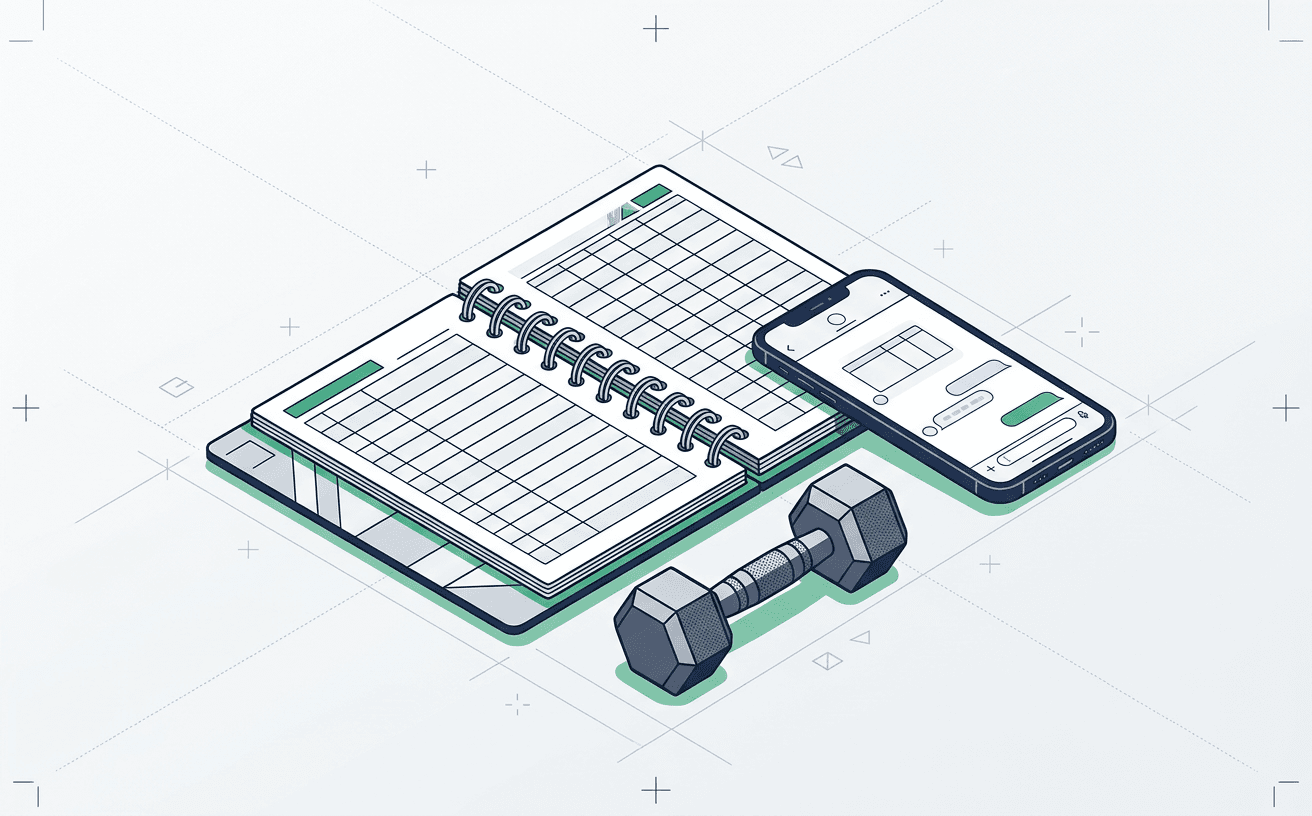
Yes, with limits. AI can compare your logged sets and suggest a next load or rep target, but it cannot see your form, feel your effort or diagnose pain. Use it to organize your training log, then check every suggestion yourself before you lift.
The weekly loop
Record the exercise, load, reps, effort and relevant context after training. Use Hevy, a spreadsheet or a notebook.
Copy the prompt and template, fill in your real numbers and paste both into your chosen AI tool. Resupply your log each time; don't assume the tool remembers it.
Compare the suggestion with your program, equipment and recovery. Correct errors before you lift.
Compare the next session with the last comparable one. An extra rep, a small load increase or cleaner execution can be progress. Holding steady is valid too.
Need a repeatable starting schedule first? Build a free workout week. This prompt picks the next target for the plan you already have; it doesn't replace an AI workout planner or a coach.
Pick your tool
The prompt below is plain text, so it works in any chat tool. What matters is the log you give it, not the brand.
Paste the prompt, then your completed log in the same message. Ask it to flag anything it assumed.
Works the same way. If a table is hard to read, ask for the answer as a short list per exercise.
Same plain-text prompt. Check that it kept your units and per-side or total load convention.
Copy and paste
This is a tool for evaluating your next target, not a coach watching your movement. Paste it into the AI tool you choose, then add your completed log below it.
Act as a cautious training-log assistant. Help me choose a target for my next comparable session using only the information I provide. Do not create a new program unless I ask.

For each exercise, compare like with like: exercise and equipment, load units, working sets, rep range, reps in reserve (RIR), technique and available weight increments. Ignore warm-up sets when assessing progression. If an essential detail is missing or unclear, ask rather than invent it.

Use this double-progression starting rule, not a guarantee:
- If all working sets reach the top of my rep range at the target RIR with consistent technique and no concerning symptoms, suggest the smallest available load increase and aim within the lower end of the range next session.
- If the sets are not all at the top, keep the load and suggest adding a rep where appropriate while staying in range and at the target RIR. If I cannot do that, holding steady is fine.
- If fatigue, recovery or performance is poor, suggest holding or reducing load or sets and explain why. Do not force a weekly increase. If the available jump is too large, keep the load and build reps or use a smaller increment if available.
- If I report sharp, worsening or unusual pain, tell me to stop that movement and seek qualified advice. Do not diagnose injuries or recommend training through pain.

Return a concise table with: exercise, last working sets, suggested next load and rep target, and reason. Clearly label assumptions and uncertainty. I will check the recommendation against my own program and how I feel before training.

Here is my log:
[Paste the completed log template here]
You can also select and copy the text manually.
Keep the signal
Use one entry per exercise. RIR means reps you estimate you could still perform with good form. If you didn't record it, say unknown rather than guessing.
Date and exercise:
Equipment and load convention (total, per dumbbell, added weight, etc.):
Load and units (lb or kg):
Working sets and reps (exclude warm-ups):
Target rep range and target RIR:
Actual RIR for each working set (or estimate / unknown):
Smallest available load increase:
Technique and relevant recovery notes:
Previous comparable session (optional):
Current program instructions or restrictions:
You can also select and copy the text manually.
An example, not a prediction
Imagine a lifter using the same hack squat machine: three working sets, a target of 8–12 reps at 1–3 RIR, and a 5 lb total increase available. The examples below are illustrative, not James's training data.
Last: 200 lb × 12, 12, 12 at 1–3 RIR with consistent technique. Next: try 205 lb for three sets within 8–12 reps, aiming toward the lower end while keeping the target RIR. The exact reps are not guaranteed.
Last: 200 lb × 12, 10, 9 at 1–3 RIR. Next: stay at 200 lb and, if appropriate, aim to add a rep to a set without sacrificing form or effort targets. Don't force it.
Last: performance dropped and fatigue was unusually high. Next: consider holding or reducing load or sets, then reassess. Sharp, worsening or unusual pain means stop the movement and seek qualified advice.
This is double progression: build reps within a range, then add load when you're ready. The size of the increase depends on your equipment and the exercise. A review of resistance-training loads found muscle can grow across a range of loads when training is sufficiently challenging; it does not validate any particular AI prompt or weekly increment.
Give it context
"Build me a leg day" is a reasonable request, but if the AI doesn't know your goal, training history, equipment or constraints, it fills in the blanks. The result can be a polished plan that isn't right for you. Use five parts: goal, training log, constraints, decision and unknowns.
Say what you are trying to change. "Bring up my quads and hamstrings while maintaining my upper body" beats "build muscle".
Exercises, working sets, reps, load and, when you have it, reps in reserve. Paste recent sessions yourself unless the tool truly has access to your app.
Days you can train, equipment, time, exercises you can't do comfortably. A plan that ignores your life is a plan you won't follow.
Ask for one reasonable change, not a textbook: "Based on this log, what's one adjustment I could consider next week, and why?"
Ask what it can't tell from your log. A log can't measure hormones, satellite-cell activation or new muscle growth.
"Build me a leg day."
"My priority is quad and hamstring size. I can train legs twice a week, have access to a hack squat, leg press and curl machines, and I've included my last two sessions below. Suggest one adjustment, explain the tradeoffs, and tell me what you still need to know."
The second prompt doesn't guarantee a better program. It gives the AI context, limits the task and makes it easier for you to spot assumptions. Want a broader review instead of a next-session target? Copy this one.
Act as a practical bodybuilding coach. Review the training information below.

My goal: [muscle-building goal and priority areas]
My experience: [training history]
My recent workouts: [exercises, working sets, reps, and effort]
My constraints: [days available, equipment, injuries, recovery concerns]

Give me:
1. What my log actually shows
2. One possible concern or opportunity
3. One adjustment to consider next week
4. What you cannot determine from this information

Don't invent missing data or claim to measure my hormones or muscle growth. Ask a follow-up question if an important detail is missing.
You can also select and copy the text manually.
For size
If your goal is muscle size, the log-based approach above is a way to personalize a muscle building program rather than follow a generic one. Keep a rep range you can train through, log reps in reserve, and let the AI compare sessions while you decide what to change.
What the research says
AI can help you organize, track and adjust your training. The studies so far do not show that AI coaching builds more muscle than competent conventional programming, and they measure different things: a coach rating a plan is not the same as someone gaining muscle, and a stronger squat is not the same as hypertrophy.
Ask your assistant to work within these anchors from the American College of Sports Medicine's 2026 position stand, which draws on 137 systematic reviews of healthy adults, rather than asking for the "most advanced" routine. They are not individual rehab advice.
| Variable | Evidence-based anchor | What AI should help you do |
|---|---|---|
| Frequency | Train at least twice weekly and engage all major muscle groups. | Fit sessions around a realistic schedule. |
| Volume | Higher weekly volume enhances growth, and the reviewed hypertrophy prescriptions use at least 10 sets per week per muscle group. The exact optimum is uncertain. | Show weekly set totals and avoid unexplained jumps. |
| Effort | Near-failure work, or roughly 2-3 reps in reserve, can provide enough effort. | Record how challenging sets actually felt. |
| Failure | Momentary muscular failure is not necessary for hypertrophy benefits. | Avoid prescribing failure on every set. |
| Progression | Increasing the stimulus is likely important for continued longer-term progress. | Adjust reps, load or volume when your performance supports it. |
Strength and size overlap but are not the same outcome. A network meta-analysis of 119 hypertrophy studies and 3,364 participants found higher-load prescriptions generally did better for strength, while few comparisons showed clear differences for hypertrophy (BJSM). So when an app celebrates an estimated strength record or pushes you to swap exercises for novelty, remember the better plan is usually the repeatable one with enough challenging work. See the volume and frequency meta-regression for the dose-response detail.
A significant improvement in one group and a non-significant one in another does not prove the groups differ. Likewise, improving while using AI is not the same as improving because of it. Judge an AI coach by the quality of its adjustments and the relevance of its measured outcomes, not the confidence of its prose. Model rankings are context-dependent too: one expert evaluation found detailed inputs improved plan quality and rated GPT-4 plans above Gemini plans, but rater agreement was low and the versions tested were specific.
Compare your options
"AI fitness" bundles different mechanisms. A chatbot generates language, an adaptive app adjusts from your logs, a camera assesses visible movement, and a wearable supplies a readiness proxy. None of them is interchangeable evidence of muscle growth.
| Approach | Feedback mechanism | Best-fit use | Main limit |
|---|---|---|---|
| General-purpose chatbot | What you tell it, in conversation. | Explaining concepts, drafting a routine, summarizing a log. | Plan quality depends on your inputs and the model version. Expert ratings are not hypertrophy trials. |
| Adaptive workout app (such as Fitbod) | Logged sets, reps, loads and effort. | Adjusting a routine and cutting planning effort. | Only as good as the log. Vendor-described features do not establish superior muscle growth. |
| Camera or connected machine (such as Tonal Smart View) | Movement analysis and visual cues. | Reviewing technique and rep consistency. | Camera angle and validation matter. Cues are not medical clearance. |
| Wearable readiness score | A physiological proxy such as heart rate variability (HRV). | Extra context for recovery decisions. | An older-women trial found no added hypertrophy benefit from HRV-guided recovery. |
| Qualified human coach | Observation, conversation and ongoing adjustment. | Complex lifts, individual feedback and accountability. | Access and quality vary. One supervision trial found a benefit for squat strength, not every lift. |
The useful distinction is time horizon. Before a session, a language tool can help organize decisions. During training, movement feedback directs attention to execution. Across weeks, logged performance supports adjustments. A restrained hybrid works best: start with a repeatable program and a reliable log, use AI for explanation and organization, add adaptive tools only when they remove a real obstacle, and get human feedback when technique or symptoms exceed your judgment. That is a practical recommendation, not a claim that a hybrid has proven superior in a hypertrophy trial.
Fitbod, for example, says it uses your completed weights, reps and sets to adjust future workouts, and that it is conservative on unfamiliar exercises and after a break. It also notes its RIR handling does not account for fatigue carried over within a superset, which is a concrete reason to keep a human override. Read how Fitbod decides your sets, reps and weight. These are vendor descriptions, not independent proof of superior hypertrophy.
Fuel and recovery
AI can organize menus, suggest swaps and summarize a food log. Its output is only useful if the target is sound and the quantities behind it are reasonable. Sources: protein meta-analysis, ISSN position stand and a sleep-restriction study.
About 1.6-2.0 g of protein per kg of body weight per day is a practical starting range for a healthy adult lifting to build muscle. It is not a medical prescription. A meta-analysis of 49 studies and 1,863 people estimated a plateau near 1.62 g/kg/day for gains in fat-free mass, with real uncertainty around that number. Sports-nutrition guidance places most exercisers between 1.4 and 2.0 g/kg/day. For an 80 kg adult, 1.6-2.0 g/kg works out to 128-160 g a day.
In a test of ChatGPT on 114 meal photos, the average signed energy error was only 0.1%, but the mean absolute difference across nutrients was 26.9%, and it underestimated meal weight in 87 of the 114 photos. Over- and under-estimates canceled out in the average while single meals stayed far off. Let AI draft the entry, then correct ingredients and portions from labels or a scale when accuracy matters.
In an eight-week study of 17 resistance-trained people, faster body-mass gain mostly added fat rather than consistently improving size or strength, and the intended calorie surpluses were not always reached. It does not establish an ideal surplus. Judge the scale alongside your lifts and how you look and feel.
In 24 young men, five nights with four hours in bed lowered myofibrillar protein synthesis compared with normal sleep. That is a short-term finding, not a forecast of how much muscle you would lose, but it supports guarding your sleep rather than expecting software to make up for it.
NIH describes a common maintenance intake of 3-5 g a day for creatine monohydrate and notes that weight gain can include water retention. Don't count every scale increase as new muscle.
Second opinions
Tonal describes camera-based cues for symmetry, balance, range of motion and pacing, and lets you review clips afterward. That is a product description, not a trial showing more muscle or fewer injuries. Research on OpenPose shows camera angle affects pose-estimation validity, and a systematic review of 13 movement-assessment studies found most classifiers reached 70%-90% accuracy but also found method errors and weak generalizability. Use a camera to answer a specific question, such as whether your reps look consistent, and get another view or a human when it conflicts with what you feel.
In a randomized trial of 21 older women over seven weeks, HRV-individualized recovery did not beat fixed recovery on any muscle, strength or function measure (no significant group-by-time effect). That does not prove readiness data is useless. It means a plausible signal showed no added benefit in that group. Use a low score to prompt a check of sleep, symptoms and recent performance, not to cancel or force a session automatically.
Sources: Tonal Smart View, OpenPose camera-angle validity, a systematic review of movement assessment and the HRV recovery trial. Whatever the tool says, movement and readiness feedback should inform your judgment, never override pain, unusual symptoms or clearly worsening technique.
Know the edges
AI works on the information layer: the sets, reps and notes you give it. It doesn't sense your body. Here is where that line falls.
| Task | Rating | What AI does | What you do |
|---|---|---|---|
| Compare logged sets and suggest a next target | Useful | Useful when the log is complete and the units are clear. | Check load units, per-side versus total weight and your available increments. |
| Spot patterns in your data | Useful | Can flag stalled loads, missed sets or protein gaps in what you logged. | Treat each flag as a question to investigate, not proof of a cause. |
| Draft a workout plan | Use with checks | Can produce a draft from your goal, history, schedule and equipment. | Review it against your constraints. It is a draft you check, not a final program. |
| Summarize or explain research | Use with checks | Can translate a study into plain language. | Open the original paper. Confirm it exists and that its population and outcome match the claim. |
| Know how hard a set felt | Use with checks | Only knows what you tell it. | Log reps in reserve, or write "unknown" instead of guessing. |
| Check your form or technique | Not possible | Cannot see, spot or feel you move. | Use a coach, a training partner or video review in context. |
| Diagnose pain or unusual symptoms | Not possible | Cannot examine you or establish a cause. | Stop the movement and consult a qualified healthcare professional. |
| Coach you live in the room | Not possible | Is not there to cue you mid-set or on stage. | Rely on an in-person coach for real-time feedback. |
Is AI good for workout plans?
AI can be useful for drafting and organizing, and still sound confident when it's wrong. Watch for these before you act on an answer.
"This stance isolates the outer quad" sounds precise. Muscles rarely switch on and off by foot position or grip, and reliable muscle-head targeting from toe position isn't established. Ask for the evidence before you reorganize a session around a cue.
An AI can name a study that doesn't exist or misdescribe one that does. Find the paper yourself and check that its participants and measured outcomes match the claim.
No chatbot can promise how many pounds of muscle you will gain by a date. Results depend on training, food, sleep, genetics and consistency.
Beware cues that push a joint to its limit, skip warm-ups or encourage grinding through sharp pain. Pain that is sharp, worsening or unusual means stop that movement.
If it never asked about injuries, equipment, schedule or training history, it filled the blanks itself. Add the context and ask again.
Both, not either
I'm James Harrison, a natural bodybuilding competitor and the creator of Gymmy. I use AI as a coaching assistant alongside a human coach, and they do different jobs.
"AI has seen a lot of images of humans in shape. So when you show it a nice picture, it's gonna tell you you're in shape. It'll tell you all the things you want to hear. But it won't tell you the details you're lacking to be a winner on stage."
Touch, spotting, live cues and specific feedback based on what they see in your body. My posing coach could keep a finger in my back to make sure a muscle stayed activated through a transition. AI has no hands.
Availability at any hour, patience for ten questions a day and a second set of eyes on the data you log. I treat it as extra credit on top of coaching, not a replacement for it.
A 10-week randomized trial compared in-person supervision, an app-guided program and a self-directed PDF. Of 112 people enrolled, 79 were analyzed after an adherence threshold. Supervised lifters improved squat strength more than the app and PDF groups, while bench-press gains did not differ significantly between supervised and unsupervised groups. The app was not identified as AI-based, so this is not an AI-versus-human verdict, and the study had limits including age differences and no dietary control.
Use this page the same way: let the prompt organize your log and suggest a target, then bring your own judgment and, when it matters, a human who can see you move.
Use judgment
Common questions
Sources
Primary studies, position statements and vendor documentation behind the claims on this page. Vendor pages describe features; they are not trials.
A good log starts with a plan you can follow. Build a free workout week, then use your own results to guide the next step.